What Are Compound Words? Meaning, Types, and Easy Examples
A compound word is made by joining two smaller words to create one new word with its own meaning. You already know many of them, even if the name sounds new.
Words like "notebook," "sunflower," and "ice cream" show up all day in reading and speech. Once you spot the pattern, compound words stop feeling tricky and start feeling familiar.
Start with the basic idea, then look at the three common forms and a few easy ways to recognize them.
The Simple Meaning of Compound Words
So, what are compound words in plain English? They are words built from two smaller words that work together as one idea. The new word may look simple, but it doesn't always mean exactly what each part means on its own.
That detail matters. A regular word pair keeps two separate jobs. "Blue car" means a blue car. "Bluebird" names a certain kind of bird, so it acts as one word with one meaning.
How Two Smaller Words Become One New Word
When two base words join, they create a fresh meaning. "Toothbrush" comes from "tooth" and "brush," but together they name one tool. "Sunflower" is not any flower under the sun. It is a specific plant.
Some compound words stay close to the meaning of both parts. Others shift a little. A "notebook" is more than a note plus a book. It is a book made for writing notes.
Why Compound Words Show Up Everywhere
You'll see compound words in school books, storybooks, menus, road signs, and text messages. Because they pack meaning into a small space, they make everyday language quicker and clearer.
They also help you grow your vocabulary faster. Teachers use them often because familiar parts can unlock unfamiliar words. If you know "rain" and "coat," then "raincoat" is easier to understand.
The Main Types of Compound Words With Clear Examples
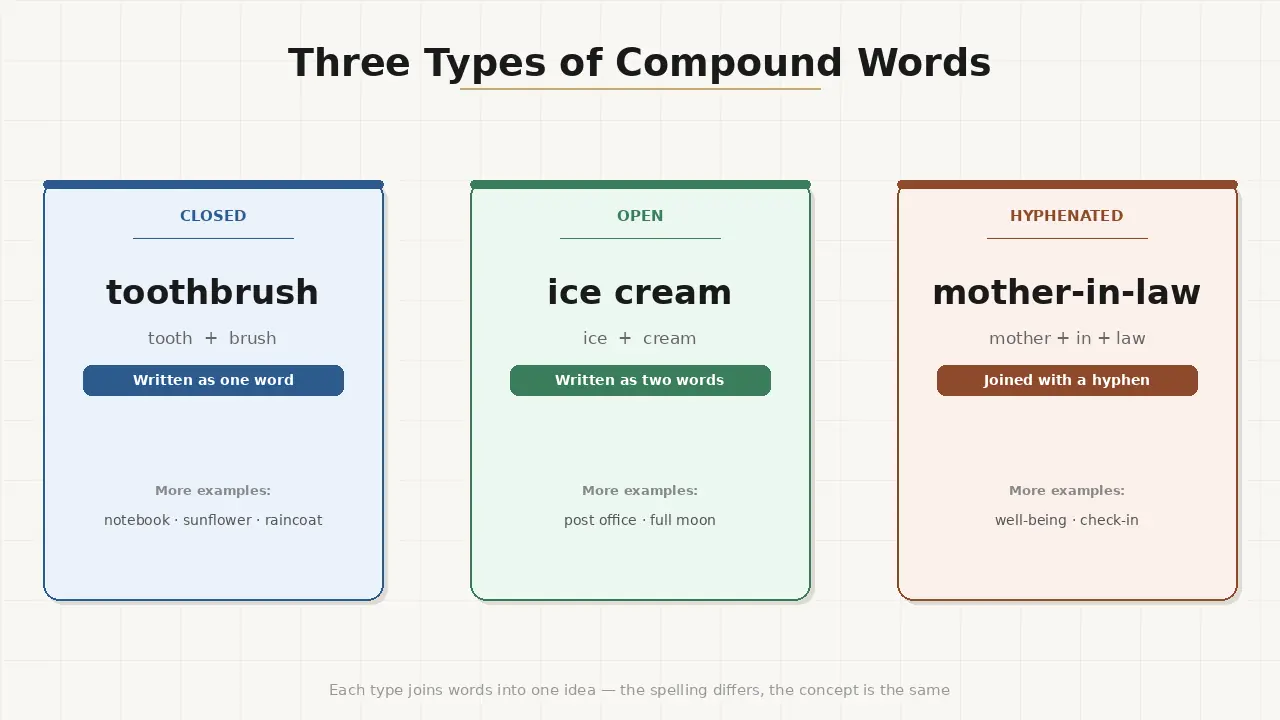
Compound words come in three common forms: closed, open, and hyphenated. The spelling changes, but the core idea stays the same.
Closed Compound Words Written as One Word
Closed compound words are written as a single word with no space. Common examples include "toothbrush," "notebook," "sunflower," "raincoat," and "mailbox."
These often look like ordinary single words once you've seen them a few times. Still, each one started as two smaller words that joined and settled into one form.
Open Compound Words Written as Two Words
Open compound words stay separated by a space, but they still express one idea. "Ice cream," "post office," and "full moon" are good examples.
This is where many readers get confused. Two words on the page do not always mean two separate ideas. In "post office," the words work together to name one place, not any office connected to a post.
Hyphenated Compound Words Joined With a Hyphen
Hyphenated compound words use a hyphen to connect the parts. Examples include "mother-in-law," "well-being," and "check-in."
The hyphen helps readers see that the words belong together. It can also prevent confusion, especially when the combined meaning needs to stay clear at a glance.
Easy Ways to Tell Whether a Word Is a Compound Word
You don't need a grammar book to spot compound words. A few simple checks usually do the job. After a little practice, your eyes start catching them on their own.
Look for Two Words Working Together as One Idea
Start by asking whether the words name one thing, one person, one place, or one idea. "Basketball" names one sport. "Bus stop" names one place. "Bedroom" names one room in a home.
Now compare that with a regular phrase. "Red balloon" is usually not a compound word because it still means a balloon that is red. The words describe something together, but they do not form a new dictionary word or fixed idea.
Watch for Meaning Changes After the Words Join
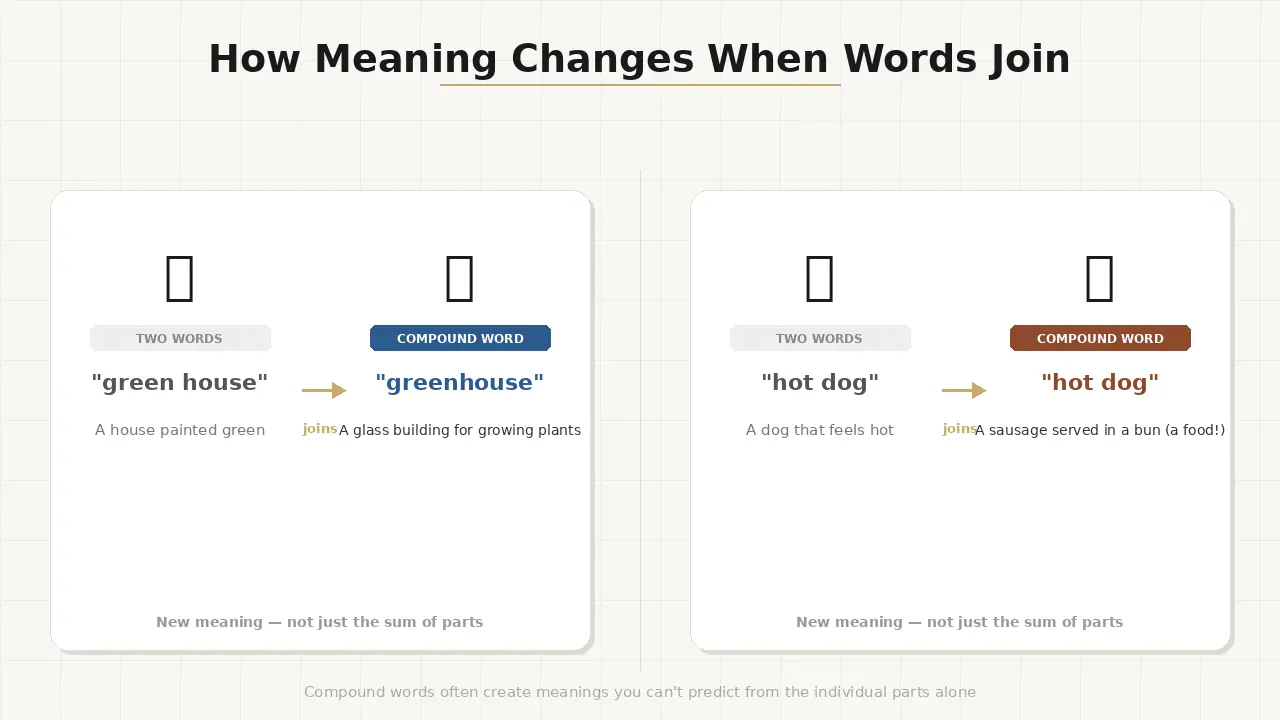
The best clue is a meaning shift. A "green house" is any house painted green. A "greenhouse" is a glass building where plants grow. That small spelling change marks a big meaning change.
The same thing happens with "hot dog." The compound word names a food, not a dog that feels hot.
Conclusion
Compound words are easier than they first seem. Two smaller words join, and together they create one new word or one fixed idea.
Once you know the three forms — closed, open, and hyphenated — you can spot them much faster. Keep "toothbrush," "ice cream," "mother-in-law," and "greenhouse" in mind, and the pattern sticks.
The next time you read a sign, a book page, or a text, look for two words acting like one. That simple habit makes compound words easy to recognize and easier to understand.